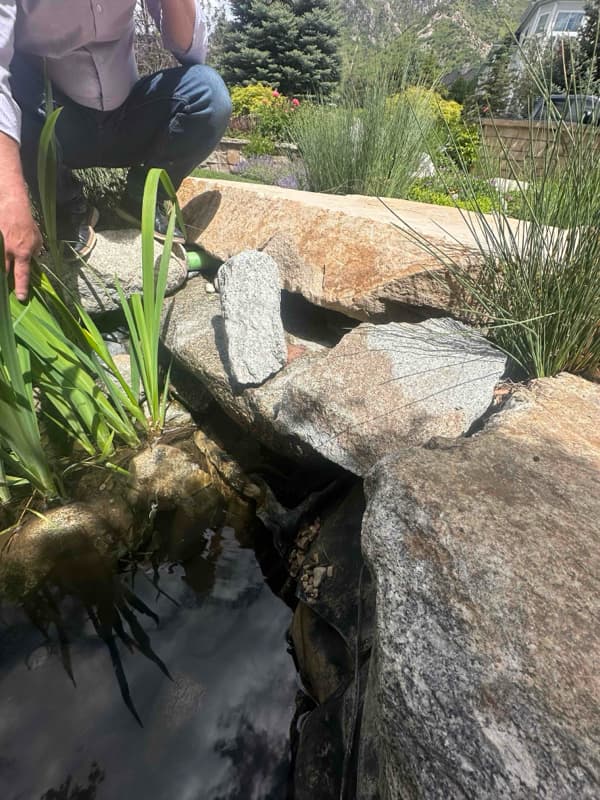
Start with When the Water Disappears
Does your pond lose water while the waterfall is running, while it is off, or both? That comparison is one of our most useful starting points. We also ask when the loss began, how often you refill, how much sun and wind the feature receives, and how much water surface is exposed.
A long stream, splashing waterfall, or fountain can lose water differently from a sheltered basin. There is no single evaporation allowance that diagnoses every Utah pond.
Photograph the feature and note what has changed.
Record the level with the autofill off and equipment conditions noted.
Use the pattern to narrow the search before choosing a repair.
When Water Loss Needs Prompt Attention
If you can see the running feature sending water outside the pond, stop the pump and contact us. A falling level can leave the pump without sufficient water. Fish also need an appropriate aeration plan when circulation is stopped.
Call before testing if fish are struggling, you are unsure how to maintain aeration, or freezing could prevent a safe restart. See our winter shutdown guidance for cold-weather concerns.
How We Ask Customers to Check Overnight Water Loss
- Plan for fish and equipment. For ponds with a substantial fish population, we recommend a separate aerator during the pump-off test. A fountain can itself lose water through spray; note whether it remains on.
- Stop the pump and allow returning water to settle. Water from the stream and waterfall may drain back into the basin. Take the starting measurement after that return has settled.
- Check the liner edge before filling. The level you think is normal may actually be above a low liner edge. Walk around accessible edges and use the highest safe level contained by the liner, not the top of the decorative rocks. If you cannot establish that level, ask us before filling higher.
- Turn off the autofill. Mark the level with chalk or crayon on a suitable visible reference, photograph it, and record the time.
- Compare the next morning. Photograph the same reference and record the change, weather, and equipment left running. Overnight reduces the influence of daytime evaporation; it does not eliminate evaporation.
Do not leave a rapidly draining pond unattended or allow the test to endanger fish. Rain, added water, or an active autofill can make the comparison unreliable.
What the Test Can Tell You
The basin holds water when the pump is off
If loss returns when the feature runs, investigate the waterfall, stream, splashing, misting, and operating plumbing. More exposed water while running can also increase evaporation. The result narrows the search; it does not prove a liner hole.
The basin loses water with the pump off
Look more closely at the basin, low edges, and connected fittings or plumbing. Some evaporation still occurs. If water repeatedly stops at a particular elevation, photograph that level and nearby rocks or penetrations rather than assuming the hole is directly beside them.
The result is unclear
Share the measurements and photos. We may need a different test or additional observation before recommending repairs.
Why a Pond Can Seem to Start Leaking When Sprinklers Shut Off
Some autofills are supplied by the irrigation system. An existing leak may be continually topped up during the watering season. When irrigation shuts off, replacement water stops and the falling level suddenly becomes obvious.
That timing does not establish that a new leak appeared or that a recent maintenance visit caused it. Spring irrigation startup can conceal the same problem again. Check where your autofill gets its water and whether it has been replacing losses.
A higher water bill, a utility notice, or unusually clear water alongside frequent refilling can prompt investigation. Clear water alone is not proof of a leak.
Splashing, Misting, Plants, and Wicking
Watch the moving water. Wind can carry spray outside the feature, and a fountain adds another possible source of loss. Trailing plants can redirect flow over an edge.
Sediment or geotextile fabric bridging a wet area and the outside can wick water away. Fabric exposed above the water can also hold moisture where it evaporates. Fabric is not automatically a problem; its placement and contact with the water matter.
Take overview photos from several angles, then close-ups showing escaping water, wet edges, exposed fabric, or suspect plants.
Small Rocks Can Change the Whole Flow
Winter movement, animals, and growing plants can change the route water takes. Even a small rock upstream can redirect flow farther downstream. Sometimes the solution is restoring flow through the middle of the channel rather than patching a liner.
After documenting and testing, you can reposition a small, accessible rock if you feel capable and can clearly see it causing splash-out. Observe the result. Leave heavy or supporting rocks, concealed liner, and uncertain repairs to the crew.
Our general design guideline is a rock-lined channel around three feet wide and one foot deep, with water contained in the center rather than filling it to the brim. This is not a universal specification: flow, rock placement, liner height, and the receiving basin all matter. A projecting waterfall without enough catchment can increase misting and splash-out.
What Happens During a Leak-Detection Visit?
Your observations help because our crew sees only a brief window of the pond's behavior. If we need to perform and revisit tests ourselves, additional trips add cost.
We prefer dry conditions for inspecting visible water loss. We generally run the feature, start around the pump area, inspect pond edges, and follow the stream and waterfall looking for splashing, misting, wicking, and low edges.
Where appropriate, we may lift accessible edge rocks to find the liner. Buried edges or fabric covering the liner make inspection more difficult. Tell us about previous repairs and share any earlier photos or service records.
Patch the Liner or Replace It?
Locating the source is a major part of the work. Then we evaluate whether it can be repaired reliably. One accessible defect may be a candidate for patching; repeated patches, multiple damaged areas, or extensively torn liner can shift the recommendation toward replacement.
We discuss access, the extent of damage, your budget, and the tradeoffs before recommending a direction. Avoid applying random sealants to liner or concrete: repair materials need compatible surfaces and proper preparation, and an unsuccessful repair can complicate the next one.
Because we often did not build the feature and cannot see what is beneath the rocks, we assess scope individually rather than publish a fixed leak-repair price.
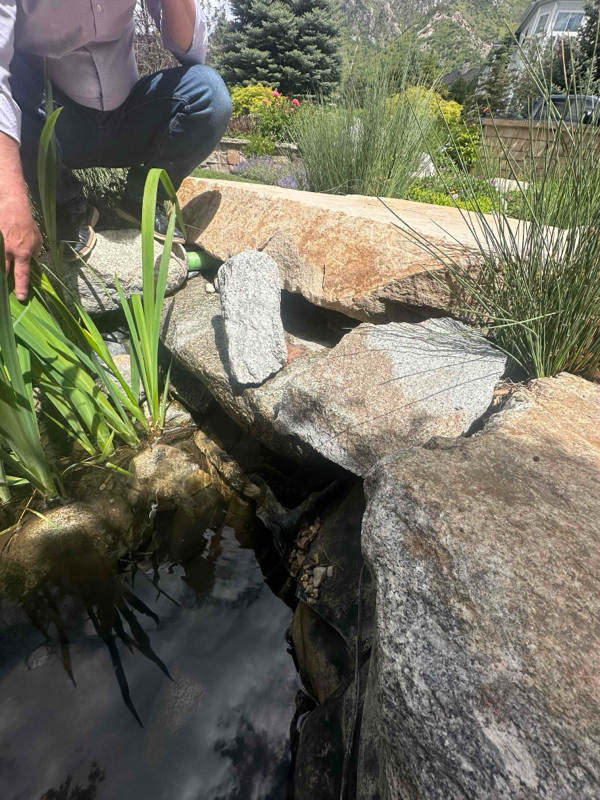
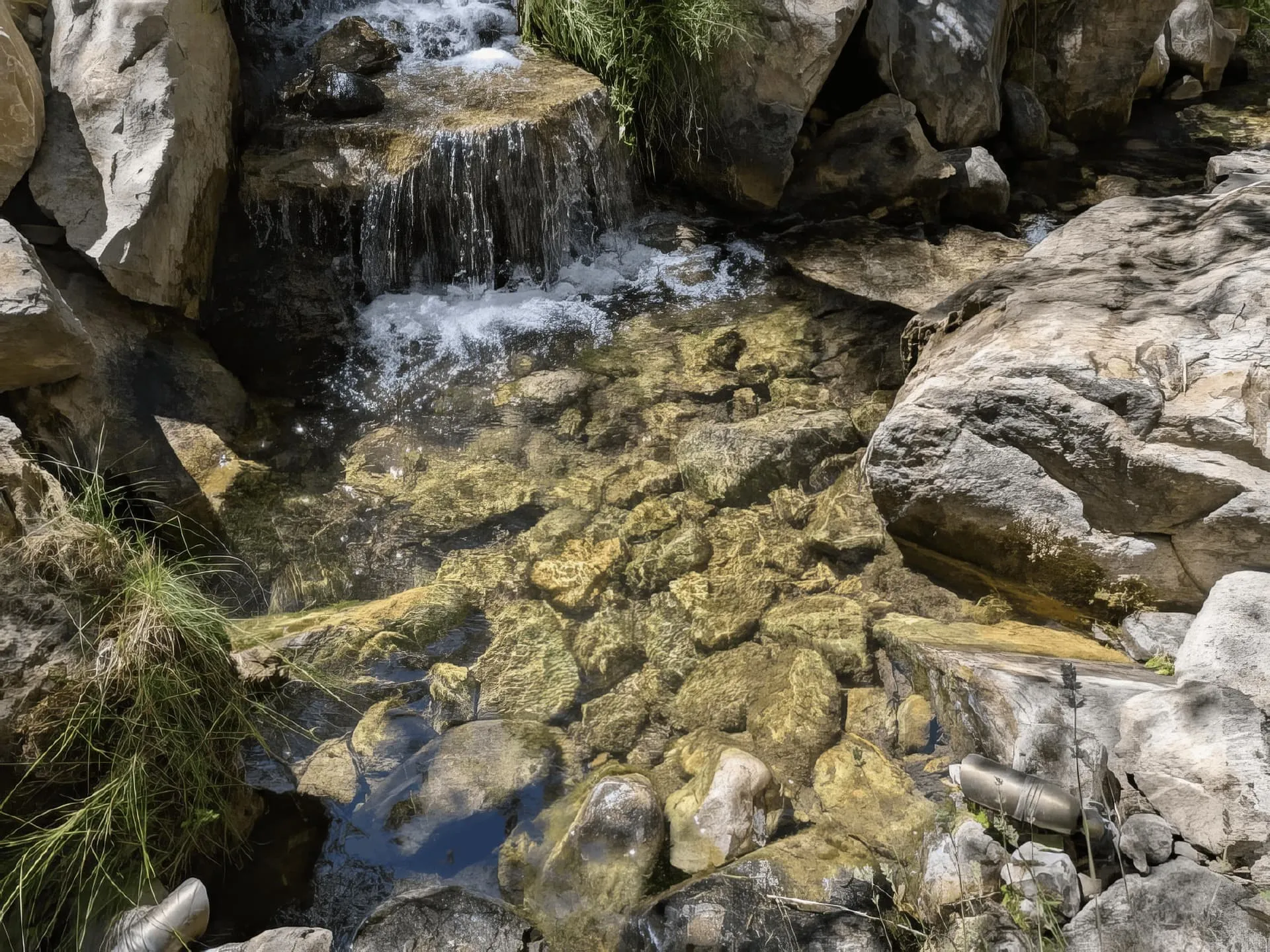
Rockwork at the Pepperwood project, photographed by our team.
More Damage Than the First Inspection Revealed
At a regular client's feature in Pepperwood, rodents had damaged the liner over winter. A cleaning brought significant water loss to attention. We used a crane to move large rocks and expose the liner.
We expected a few holes but found close to a dozen. After patching and reassembling the feature, the water-loss issue was resolved. It illustrates why access and the amount of hidden damage affect the scope of a repair.
Show Us What Your Pond Is Doing
Send overview photos, close-ups, your city, the timing of the loss, autofill details, and any overnight measurements. Do not attempt a test you are unsure about just to request help.
Request pond leak helpExplore pond repair services
Call (801) 590-8516, text photos, or visit our aquatic nursery to talk through your pictures face-to-face.